

According to the PostgreSQL announcement, the REPACK (CONCURRENTLY) command lets you optimize tables for the current workload without interrupting running operations in PostgreSQL 19. This release also adds the pg_plan_advice extension to control query plan stability. The PostgreSQL Global Development Group announced this release on Nov 19, 2026.
Quick summary
- REPACK replaces VACUUM FULL and CLUSTER; the two old commands remain for compatibility.
- REPACK (CONCURRENTLY) removes bloat without blocking reads or writes.
- pg_stash_advice can apply advice automatically without changing the application.
- In PostgreSQL 19, JIT is off by default and RADIUS support is removed.
- WAIT FOR LSN lets you read freshly written data on a standby.
What’s new in PostgreSQL 19?
PostgreSQL 19 focuses on simplifying administration and development for large-scale workloads. For developers, the announcement highlights read-your-writes consistency on standbys and get or create behavior that saves one network round trip. For query planning, pg_plan_advice gives better control over plan stability and query performance.
These three groups of changes share one goal: reducing operations that require stopping the system or modifying the application. The sections below go into the mechanism of each group, based on the description in the official announcement.
How it works and technical details
The three mechanisms below directly change how you operate and query PostgreSQL. The announcement describes observable behavior; the source does not detail the internal implementation.
How does WAIT FOR LSN ensure read-your-writes?
The WAIT FOR LSN command lets a session on a standby wait until the standby has replayed the write-ahead log (WAL) up to a specified log sequence number (LSN) before running a query. This way, the application can read data it just wrote on the primary.
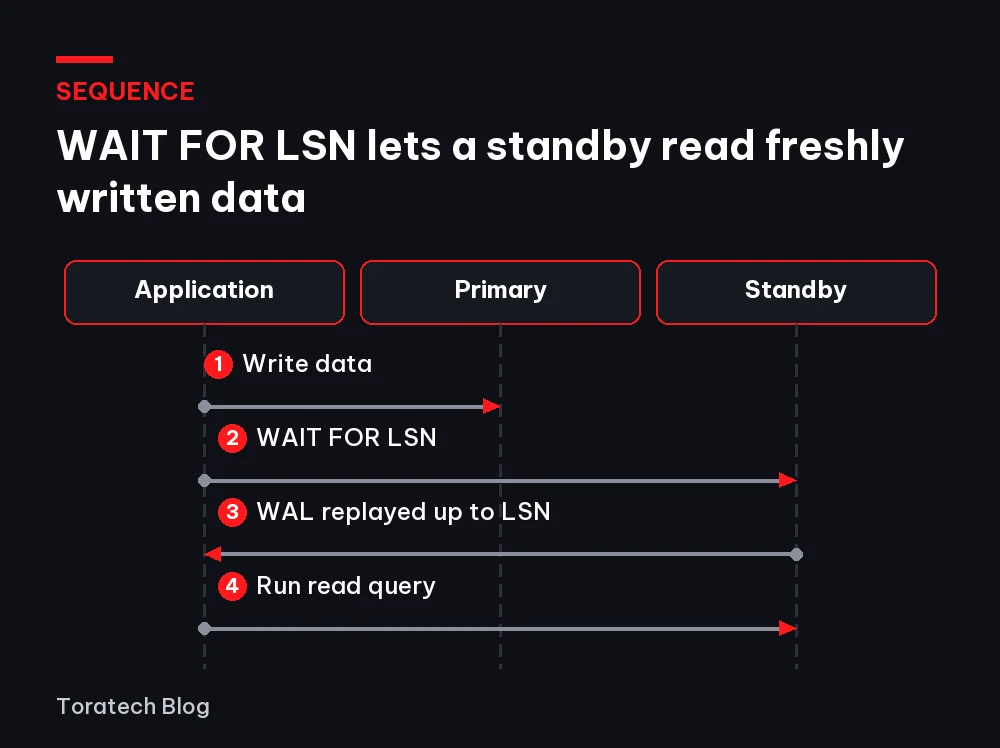
The flow has three steps: the application writes data on the primary, the session on the standby runs WAIT FOR LSN, and only then runs the read query. This is useful for applications that move read queries to a standby but still need to see newly written data.
How does REPACK remove bloat?
Tables that receive many update and delete commands can accumulate unused space, called bloat. This extra space can also significantly affect query performance.
Previously, VACUUM FULL and CLUSTER were used to handle this, but they had trade-offs, including blocking access to the table until cleanup finished.
PostgreSQL 19 introduces the REPACK command, which reclaims that space and can reorder the table’s data by an index. With REPACK (CONCURRENTLY), this happens without blocking reads or writes.
REPACK replaces VACUUM FULL and CLUSTER. The two old commands remain for compatibility, so existing scripts won’t break right away.
The block below lists the syntax mentioned in the announcement, abbreviated and not complete statements:
REPACK (CONCURRENTLY)
WAIT FOR LSN
INSERT ... ON CONFLICT DO SELECT
How does pg_plan_advice stabilize query plans?
The PostgreSQL query planner usually picks an efficient plan for each query. However, plans can change when data changes, and sometimes the new plan is slower.
PostgreSQL 19 adds the pg_plan_advice extension, which lets you stabilize plan choices and experiment with different plans using a mini-language called plan advice.
The bundled pg_stash_advice extension stores advice and applies it automatically to queries based on the query identifier. This way, you can fix a slow plan without changing the application.
Other changes and new defaults
Beyond the three mechanisms above, the announcement lists several changes that affect day-to-day operations:
- Autovacuum can now vacuum indexes using parallel workers, controlled by the autovacuum_max_parallel_workers setting, and uses a new scoring system to choose which tables to process first.
- Previously, PostgreSQL usually required a server restart to enable logical replication, which could cause disruption in production.
- PostgreSQL 19 simplifies setting up logical replication by automatically raising the effective WAL level to logical when you create the first logical replication slot.
- You can check the WAL level in use via the effective_wal_level setting.
- INSERT … ON CONFLICT DO SELECT lets the RETURNING clause return rows that already exist and conflict with the insert, simplifying the get or create pattern.
- Foreign key checking is improved, and in the announcement’s tests, bulk inserts are nearly 2x faster.
- The server supports Server Name Indication (SNI), allowing one PostgreSQL server to present different TLS certificates depending on the hostname the client connects to.
- You map hostnames to certificates and keys in the new pg_hosts.conf file.
Some defaults have also changed. JIT (just-in-time compilation) is now off by default because the cost estimates used to decide when to enable JIT proved unreliable. If you run many large analytical queries, you may want to re-enable JIT.
When PostgreSQL is built with LZ4 support, the default TOAST compression method is now lz4. With asynchronous I/O, when io_method is set to worker (the default), PostgreSQL automatically adjusts the number of I/O workers between the io_min_workers and io_max_workers settings, replacing the io_workers setting.
Impact on developers
This section is Toratech Blog’s cautious assessment, based on the facts above. You should test in a staging environment before upgrading production.
- If your system uses RADIUS authentication, check it first, because PostgreSQL 19 removes this support.
- If you still use md5 authentication, PostgreSQL 19 will warn after each successful authentication; you can turn off the warning with md5_password_warnings, but you should plan to move to SCRAM.
- If your configuration has the io_workers setting, review it because it is replaced by io_min_workers and io_max_workers.
- If you run many large analytical queries, re-measure performance with JIT off by default and consider re-enabling it.
- If your application sends read queries to a standby, you can consider WAIT FOR LSN in place of self-built synchronization waits.
The announcement says md5 has been deprecated since PostgreSQL 18 and will be removed in a future release. If you need password authentication, the source recommends SCRAM.
Impact assessment
| Audience | Impact | Level | What to do |
|---|---|---|---|
| Developers | Need to review authentication configuration and old I/O settings before upgrading. | Medium | Check RADIUS, md5 and io_workers on staging. |
| BrSE / PM | Project plans may need extra time for upgrade testing. | Medium | Ask the customer about authentication configuration and maintenance schedules. |
| Managers | The source does not state a support deadline, so there is no basis for an urgent decision. | Low | Add the evaluation of PostgreSQL 19 to the technical plan. |
Industry perspective
From Toratech Blog’s perspective, the most notable upgrade risk lies in the compatibility changes: RADIUS support is removed, md5 starts to produce warnings and JIT is off by default. The opportunity lies in operational tools such as REPACK (CONCURRENTLY) and pg_stash_advice, which may help reduce operations that require locking tables or modifying applications.
In the short term, operations teams can try REPACK on staging and re-measure query performance. In the long term, the fact that md5 is announced for removal is a signal to move to SCRAM early rather than wait for a later release.
For Vietnam–Japan offshore projects, when customers require strict change control, it may be worth preparing a list of compatibility changes to agree on the upgrade schedule and testing scope early.
Frequently asked questions
Does REPACK replace VACUUM FULL and CLUSTER?
Yes, according to the announcement, REPACK replaces VACUUM FULL and CLUSTER. The two old commands remain in PostgreSQL 19 for compatibility.
Does enabling logical replication on PostgreSQL 19 require a restart?
The announcement says PostgreSQL 19 automatically raises the effective WAL level to logical when you create the first logical replication slot. Previously, enabling logical replication usually required a server restart.
Is JIT enabled by default in PostgreSQL 19?
No, JIT is now off by default. If you run many large analytical queries, you may want to re-enable JIT.
Should I keep using md5 authentication?
You should plan to move away. md5 has been deprecated since PostgreSQL 18 and will be removed in a future release; if you need password authentication, the source recommends SCRAM.
References
- PostgreSQL News (primary source)
This article was compiled with the help of AI from the sources below.